[lang_en]Ulm School of Design[/lang_en][lang_de]HfG Ulm[/lang_de]

[lang_de]
Die Hochschule für Gestaltung (HfG) in Ulm war eine bekannte Design-Hochschule, die 1953 gegründet wurde und nur 15 Jahre bestand.
Zu den Gründern zählte der Designer Otl Aicher seine Frau Inge Aicher-Scholl, deren Geschwister unter den Nazis für ihre Arbeit in der Widerstandsgruppe „Weiße Rose“ hingerichtet worden waren der schweizer Architekt Max Bill, der u.a. am Bauhaus studiert hatte.
Gebäude
Die Gebäude der ehemaligen HfG liegen hoch über der Stadt Ulm auf dem Kuhberg. Die HfG liegt auch heute noch sehr abgelegen von der Stadt und man kann sich vorstellen, was für eine abgeschottete Welt es erst vor 50 Jahren dort oben gewesen sein muß. Diese räumliche Entfernung spiegelte sich auch in den Beziehungen zu Stadt wider. Gerade als man es sich in den Nachkriegszeiten wieder bequem und heimelig machen wollte, tauchten auf einmal diese eingenartigen Menschen auf dem Kuhberg auf und predigten die gute Form und das Ende vom Kitsch.
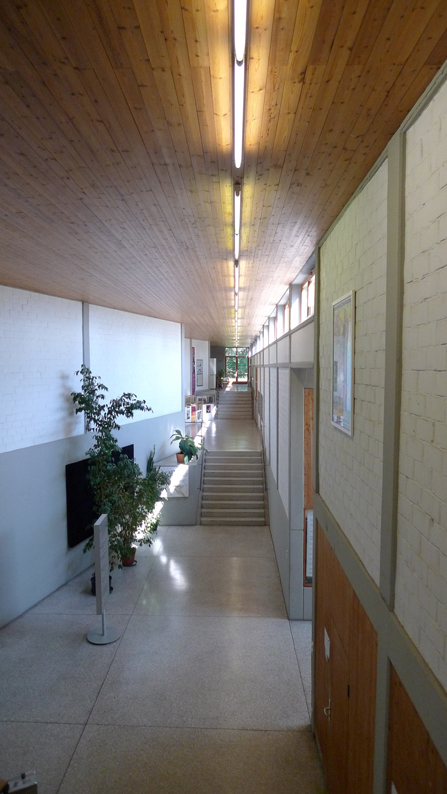
Als ich die HfG-Gebäude zum ersten mal sah, fand ich sie nur karg und eckig. Die Räume und Flure sind teilweise sehr hoch, lang und hell.
Als die HfG gebaut wurde, benutzte man nur die billigsten Materialien, Studenten und Lehrkräfte mußten selber mitarbeiten, weil einfach nichts da war, der Krieg war ja gerade erst vorbei. [/lang_de]
[lang_en]The Ulm School of Design (HfG) was a famous design school that followed the Bauhaus design. Founded in 1953 by Inge Aicher-Scholl, Otl Aicher and Max Bill with the support of the USA it became well-known for the idea that form follows function and the expression “to ulm up”. The HfG was closed in 1968.
Buildings
The HfG buildings are situated far-off the center of the provincial Swabian city Ulm. It seems that the HfG never really managed to establish a relationship to the people of Ulm. The war was just over and people struggled to get comfortable in their new realities when these strange designers from all over the world appeared in Ulm just to preach the end of German kitsch and comfy arm chairs.
When I first saw the HfG buildings I just found them cold and empty. Its rooms and halls are high and light-flooded. When it was built only the cheapest material was available and students had to help during the construction work.
[/lang_en]


[lang_de]
Innenräume
Der einzige nicht-eckige Ort der HfG war die Bar in der Cafeteria. Diese geschwungene Theke war der Ort des Zusammenkommens und des gemeinsamen Diskutierens. Es gab anfangs kein Geld für Stühle, auf denen alle Studenten hätten sitzen können. Max Bill kam deshalb auf die Idee, dass jeder Student sich erst einmal selbst einen “Ulmer Hocker” bauen mußte. Diesen trugen die Studenten dann mit sich herum in ihre Vorlesungen.
[/lang_de]
[lang_en]
Interiors
The only non-angled place at the HfG was the curved bar in the cafeteria. It was the place to eat, meet and discuss. In the beginning there weren’t enough chairs for the students. Max Bill invented the Ulm stool, a kind of makeshift chair. Each student had to assemble his own stool, a practical piece of furniture for sitting, as a table or tray. Today they are sold as expensive design product
[/lang_en]

[lang_de]Der Eingangsbereich heute[/lang_de][lang_en]The HfG foyer today[/lang_en]

[lang_de]Der Eingangsbereich damals[/lang_de][lang_en]The foyer during the 60s[/lang_en]

[lang_de]Die Cafeteria mit geschwungener Theke[/lang_de][lang_en]the curved bar[/lang_en]


[lang_de]Ganz rechts der „Sägezahn“[/lang_de]
[lang_de]
Design
Momentan werden die HfG-Gebäude als Psychologische Tagesklinik genutzt. Es gibt aber große Pläne der Stadt Ulm, an diesem Ort einen „Designpark“ einzurichten. Außerdem wird das Archiv der Hochschule auch in die HfG zurückziehen.
Außer dieser Sitzgruppe gibt es dort kaum noch Original-Inventar zu besichtigen. Allerdings gibt es im Ulmer Museum eine wirklich sehenswerte Dauerausstellung mit vielen Entwürfen der HfG.
[/lang_de]
[lang_en]Today the buildings are used as a day hospital for psychologically impaired people. But the city of Ulm is planning to establish a “designpark”. The HfG Archives are going to move back in there too. Right now there is not much to see inside except a suite of armchairs and a table. However the Ulmer Museum has a remarkable exhibition with HfG design displays.[/lang_en]


[lang_de]Original-Ulmer-Hocker[/lang_de][lang_en]Ulm stools[/lang_en]


[lang_de]Ausstellungsstücke im Ulmer Museum[/lang_de][lang_en]Exhibits at the museum[/lang_en]


[lang_de]Dieses Plakat der Entwicklungsgruppe E5 von ca. 1965 ist das einzige HfG-Teil, das ich besitze. Es wurde anlässlich des Ulmer Weihnachtsmarkts entworfen und zeigt das Ulmer Münster im Hintergrund. Zu der Zeit war der Münsterplatz ein riesiger Parkplatz. Das Plakat wurde vom Grafiker Tomás Gonda entworfen, der gebürtige Ungar kam 1958 an die HfG.
[/lang_de]
[lang_en]This poster is the only HfG piece I own. It was designed at around 1965 by Tomás Gonda who was a member of the visual design group working with Otl Aicher. The background shows the entrance of the famous Ulmer Minster which is the tallest church in the world. At that time the market sqare around the minster was a giant parking lot. [/lang_en]
[…] was totally new at the time and must have shocked some people. Just like the Bauhaus and the later HFG Ulm, Neues Bauen wanted to eradicate everything that was homey, cozy and […]
Leave a Reply
Recent Posts